Which autoclave do I need?
Sterile instruments are the basis of any safe treatment, whether in dental practices, podiatry practices, veterinary practices or tattoo studios. But which autoclave is right for your needs? An autoclave, also known as a steam steriliser, sterilises instruments with saturated steam under pressure, reliably killing germs, spores and bacteria.
This validated form of steam sterilisation is mandatory in medicine and dentistry. An autoclave that complies with DIN EN 13060 guarantees maximum hygiene and meets European standards. Find out here which autoclave class best suits your practice.
Why choose a B-type autoclave? Your advantages at a glance
- Free shipping within Germany and Austria
- Two-year warranty on all autoclaves
- Quick installation with video tutorials
- Compatible with Dios practice management software
- Expert advice and online support
- Maintenance and validation by trained technicians
As an experienced supplier of autoclaves with decades of experience, B-Autoklav supports you not only with your purchase, but also with installation, validation and maintenance.
Read MoreWhat is the meaning of autoclave classes?
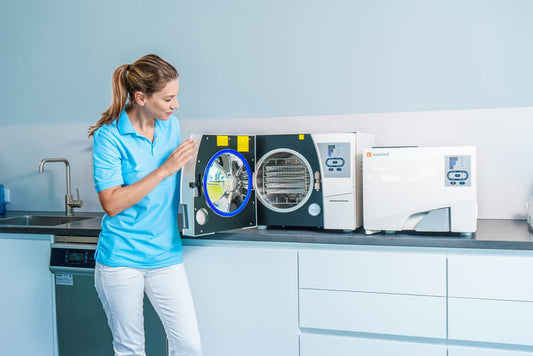
The term autoclave comes from the Latin word autoclavis and refers to a pressure-resistant container that enables steam sterilisation.Autoclaves are classified based on their performance. The three main types are class B, class S and class N. This classification describes the performance and scope of application of the steriliser and is also known internationally as the autoclave class.
| Class | Description | Typical application |
|---|---|---|
| Class B | A first-class fractional vacuum process sterilises all wrapped and unwrapped, solid, porous and hollow instruments. | For all medical and paramedical fields |
| Class S | Mid-range, sterilises only certain instruments approved by the manufacturer. | e.g. simple medical instruments |
| Class N | Basic class, only suitable for unwrapped, solid instruments. | e.g. in the laboratory or for disposable materials |
Class B autoclaves offer the highest level of safety and flexibility. We therefore recommend these devices for all professional practices that require complete sterility. Only Class B autoclaves meet all requirements for sterilisation validation in dental and podiatry practices.
A reliable factor in your practice
Please let us know how we can assist you; we are here to help.
In which areas of work are we active?
Your autoclave supplier in: the Netherlands, Germany, England, France, Spain, Belgium, Luxembourg, Austria, Switzerland
Our service
Do you have a question about our autoclaves or the ordering process? Or would you like personal advice for your practice or clinic?
Opening hours
We are available by telephone on working days from 8:30 a.m. to 5:00 p.m. You are welcome to visit our showroom by appointment, until 4:45 p.m. at the latest.
Definition and advantages of class B autoclaves
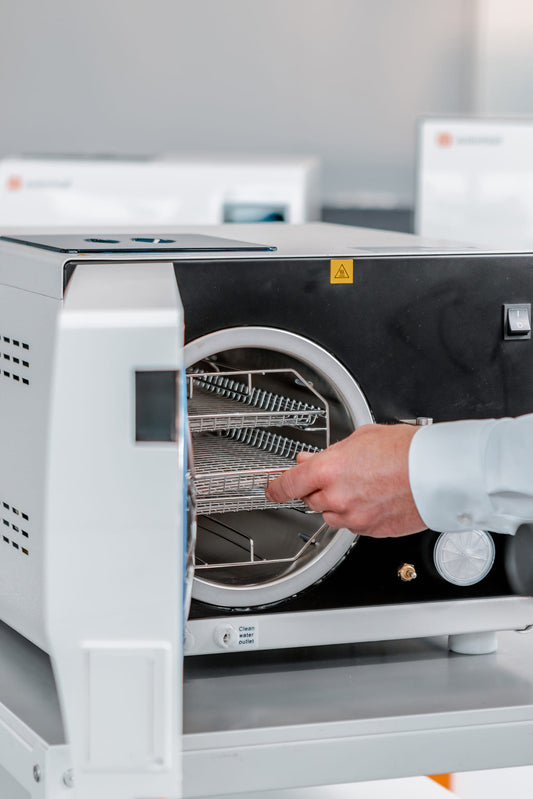
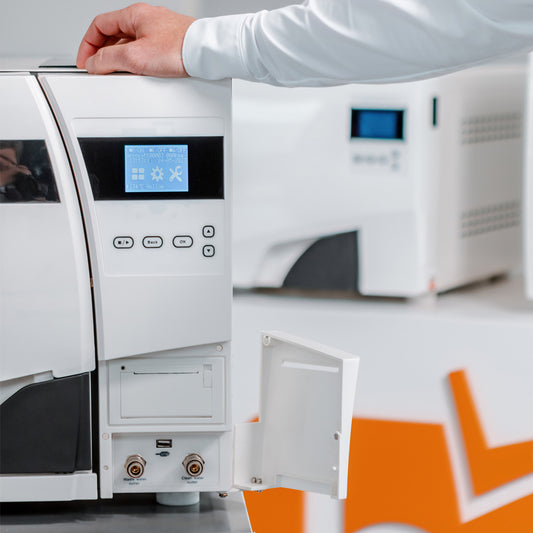
A Class B autoclave uses fractional pre-vacuum, also known as fractional sterilisation. In this process, the air is removed from the sterilisation chamber in several cycles before the hot steam enters. The result: even hollow instruments (type B) such as handpieces, contra-angles or endoscopes are perfectly sterilised.
Advantages of Class B autoclaves:
- Complete sterilisation of packaged and unpackaged instruments
- Suitable for porous materials, textiles and hollow instruments
- Automatic fractionation with helix test control
- Complies with DIN EN 13060
- Ideal for medical, dental and cosmetic applications
These Class B autoclaves are therefore the first choice for dental practices, podiatrists or medical clinics that value verified validation and maximum safety.
Read MoreAutoclave types: Freestanding or with fixed water connection?
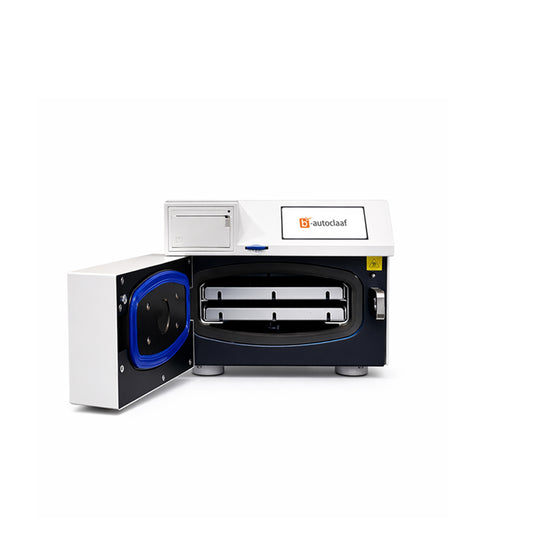
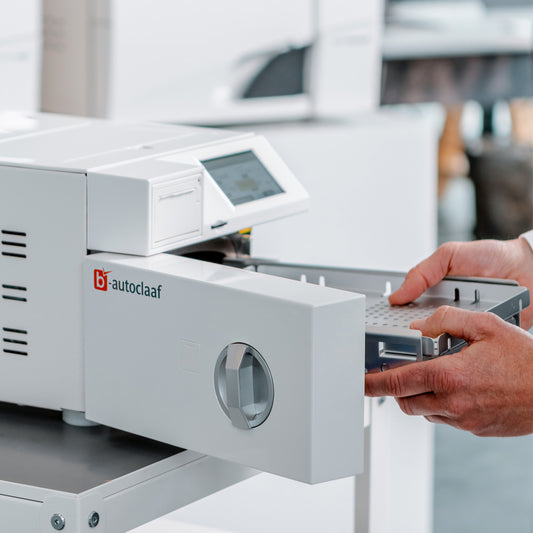
At B-Autoclave, we only offer stand-alone autoclaves. These units are extremely flexible and easy to install. All they need is a power outlet. The demineralised water is simply filled into the reservoir.
Autoclaves therefore differ not only in class, but also in water supply and capacity. For larger practices, we recommend models with a larger chamber volume (e.g. large autoclaves of 23 litres or more), while smaller practices benefit from compact autoclaves.
Advantages of the stand-alone solution
- No expensive water connection required
- Lower installation and maintenance costs
- Portable, ideal for smaller practices or studios
If you still prefer an autoclave with a water connection, we will be happy to advise you on the advantages and disadvantages of these systems.
Read MoreBeveiliging voor uw praktijk
The validation of an autoclave is an important part of quality management in any practice. It confirms that the sterilisation process is demonstrably safe and reproducible.
Our service team offers:
- Annual or semi-annual maintenance
- Validation of dental and podiatric autoclaves
- Rapid assistance with repairs and troubleshooting
- Advice on sterilisation in accordance with class B as per DIN EN 13060
Definition of dental sterilisation:
This refers to the complete elimination of all microorganisms on dental instruments using steam, documented by the Helix or Bowie-Dick test.
Read MoreThe right autoclave for every practice
Depending on the specific application, requirements vary in terms of size, cycle time and capacity. B-Autoclave offers specialised solutions for:
- Dierenartspraktijken
- Huisartsenpraktijken
- Tandartspraktijken
- Verloskunde- en kraamklinieken
- Medische klinieken
- Pedicure- en voetverzorgingspraktijken
- Piercing- en tattoostudio's
- Podotherapiepraktijken
What is an autoclave in a dental practice?
A Class B steriliser, specially designed for dental instruments and handpieces. This enables dental practices to comply with the legal requirements for sterilisation and documentation.
Read MoreRequest advice now
Not sure which autoclave is right for your practice? Our experts will be happy to advise you in person, by telephone, via video call or in our showroom.+31 (0)321 317 878
info@b-autoklav.com
Please contact us
Learn everything about our autoclaves in 10 minutes!
Frequently asked questions (FAQ)
Find the answers to frequently asked questions here, or feel free to contact us: 0031-321 31 78 78
What is an autoclave?
An autoclave is a steriliser that uses pressurised steam to completely disinfect instruments.
What does autoclaving mean?
Autoclaving is the process of steam sterilisation at 121 °C – 134 °C, which kills micro-organisms and spores.
What is the difference between an autoclave and a steriliser?
An autoclave is a special type of steriliser that uses pressurised steam; other sterilisers use hot air or chemicals.
Why should I choose a Class B autoclave?
Only class B autoclaves guarantee complete sterilisation of all types of instruments and meet the requirements of DIN EN 13060.
How often should an autoclave be validated?
Usually once a year, depending on the size of the practice and the length of time the equipment has been in use. B-Autoclave offers convenient maintenance contracts for this purpose.